
Solar Security Trailer Specs, Explained (2026)
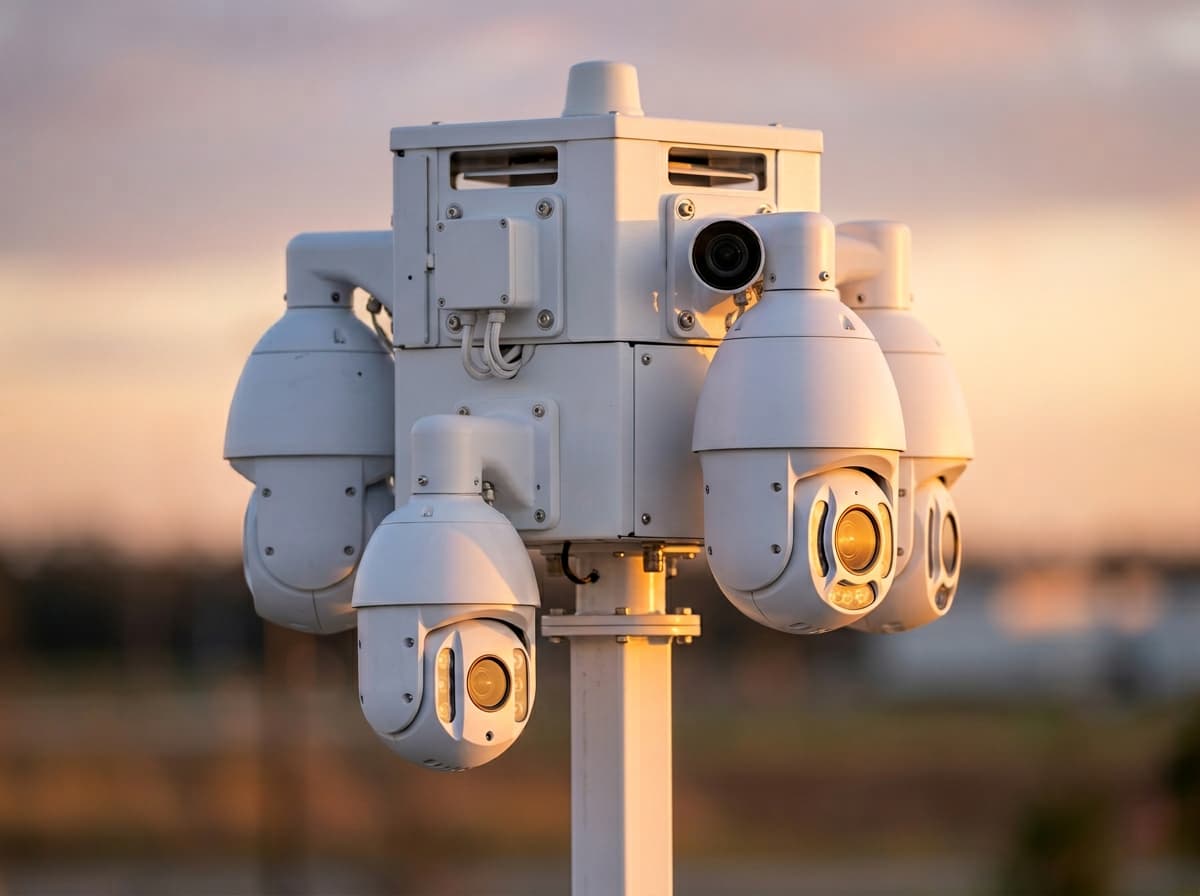
A serious 2026 solar security trailer runs 800–1,600W of panels, 8–16 kWh of LiFePO4 batteries, 5–7 days of no-sun autonomy, a mast between 20 and 30 feet, four PTZ or multi-sensor cameras, LPR on every ingress lane, thermal analytics, and bonded LTE across two carriers. Anything less will brown out in a Gulf Coast overcast stretch or miss a plate at 3am.
How much solar do you actually need on the Gulf Coast?
Houston averages 4.5–5.0 peak sun hours/day, but a wet December week can drop that to 1.5 hours. Sizing solar to the July average and forgetting the Christmas overcast is how trailers brown out.
The Guardtress spec: 1,200W nominal panel array (four 300W panels), tilted and rotatable for winter sun angle, with clear shadow-line documentation before deployment.
Battery bank and autonomy — the number that matters
Battery capacity is not marketing copy — it's the difference between a trailer that survives Tropical Storm Alberto and one that goes dark. LiFePO4 (lithium iron phosphate) is the only chemistry we deploy: 5,000+ cycle life, safe in Houston heat, and stable to 140°F.
- Capacity: 12 kWh usable minimum (Guardtress standard)
- Chemistry: LiFePO4 only — no lead-acid, no NMC
- No-sun autonomy: 5–7 days at full 24/7 monitoring load
- Charge controller: MPPT with per-panel monitoring
- Remote telemetry: state-of-charge visible to Guardtress ops 24/7
Camera stack: what to look for, what to skip
Four cameras is the floor. On the Guardtress trailer, that's two PTZ (pan-tilt-zoom) with 30x optical, one multi-sensor 360°, and one dedicated LPR camera aimed at the primary ingress lane. Thermal overlay is standard — critical for the 10pm–5am window when optical alone misses low-contrast movement.
Analytics run on-trailer: human/vehicle classification, line-crossing, and loitering. Cloud is used for verification and archive, not detection — a bandwidth-only design fails when LTE is congested.
LPR (license plate recognition): the single highest-leverage feature
LPR captures a court-usable plate on every vehicle entering the site. On a Houston jobsite this is the difference between 'someone stole a skid steer' and 'here's the plate, the driver's face, and the direction of travel at 2:47am.'
Guardtress LPR spec: 95%+ accuracy at 15–35 mph, IR-illuminated for full-dark capture, and every plate cross-checked against a subscribed hotlist. Read our what is LPR answer for the full breakdown.
Connectivity: LTE bonding, not single-carrier
Houston has coverage dead zones on the west side and inside industrial corridors. A single-carrier modem will drop uplink at least monthly. Guardtress trailers ship with bonded LTE across two carriers (Verizon + AT&T on the standard SKU), automatic failover, and enough on-trailer storage to buffer 30+ days of video if uplink is lost entirely.
Mast, footprint, and deployment
Mast height determines line-of-sight over stacked material, condos, and 8-ft chain link. Guardtress deploys with a 25-ft crank mast as the standard, extendable to 30-ft for tall perimeters. Footprint is 8×20 ft; the trailer levels on scissor jacks with no anchoring required.
How fast can Guardtress deploy this in Houston?
Standard Guardtress deployments across the Houston metro land in 24–72 hours from signed quote to live monitoring. A single solar-powered mobile security trailer covers roughly 1.5–2 acres of open ground, carries 5–7 days of no-sun autonomy, and runs on bonded cellular so it needs no site power, no trenching, and no permanent mounting. Units relocate with a standard pintle hitch as the work front moves — a real advantage on phased Houston builds where the exposure point changes every few weeks.
Every unit ships with license plate recognition (LPR), analytic tripwires tuned to human and vehicle shapes, and two-way talkdown from a live U.S.-based monitoring center. Verified events escalate to the Houston Police Department or the Harris County Sheriff's Office as a confirmed crime in progress, which moves the call up the priority queue instead of into the false-alarm pile. Site plans, camera angles, and escalation contacts are set during a 30-minute assessment before the trailer leaves the yard.
- Assessment to live monitoring: 24–72 hours
- Coverage per unit: 1.5–2 acres, 360° with LPR at entry
- Power: solar with 5–7 days no-sun autonomy, no site power required
- Escalation: verified talkdown, then HPD / Harris County Sheriff dispatch
- Service area: Houston, Sugar Land, The Woodlands, Pasadena, Baytown, Conroe, Katy, Galveston, League City, Pearland
What does this cost compared with posting guards?
Houston contract guards run roughly $28–$42 per hour loaded, so a single unarmed guard on a 12-hour night shift costs about $10,000–$15,000 per month — for one set of eyes that can only be in one place, takes breaks, and turns over often. A monitored Guardtress trailer covers the same perimeter continuously at a fraction of that, and the spend moves from a headcount line to a predictable OPEX line you can hold to the schedule.
The math usually turns on two numbers: what a single loss event costs you in materials plus schedule slip, and whether your carrier offers any credit for a written 24/7 monitoring plan — a question worth asking your broker directly. Full site-by-site pricing is in our construction site security cost guide, and the head-to-head breakdown is at Guardtress vs. security guards.
- Houston guard rate: $28–$42/hour loaded
- One 12-hour guard shift: $10,000–$15,000/month
- Monitored trailer: fixed monthly OPEX, no overtime or turnover
- Builder's risk documentation: written monitoring plan formatted for broker review
Ready to lock in your perimeter?
30-minute remote or on-site assessment. Same-day quote. Deployment in 24–72 hours across the Houston metro.
Download the whitepaper