
Site Lighting and CPTED — The Houston Jobsite Checklist
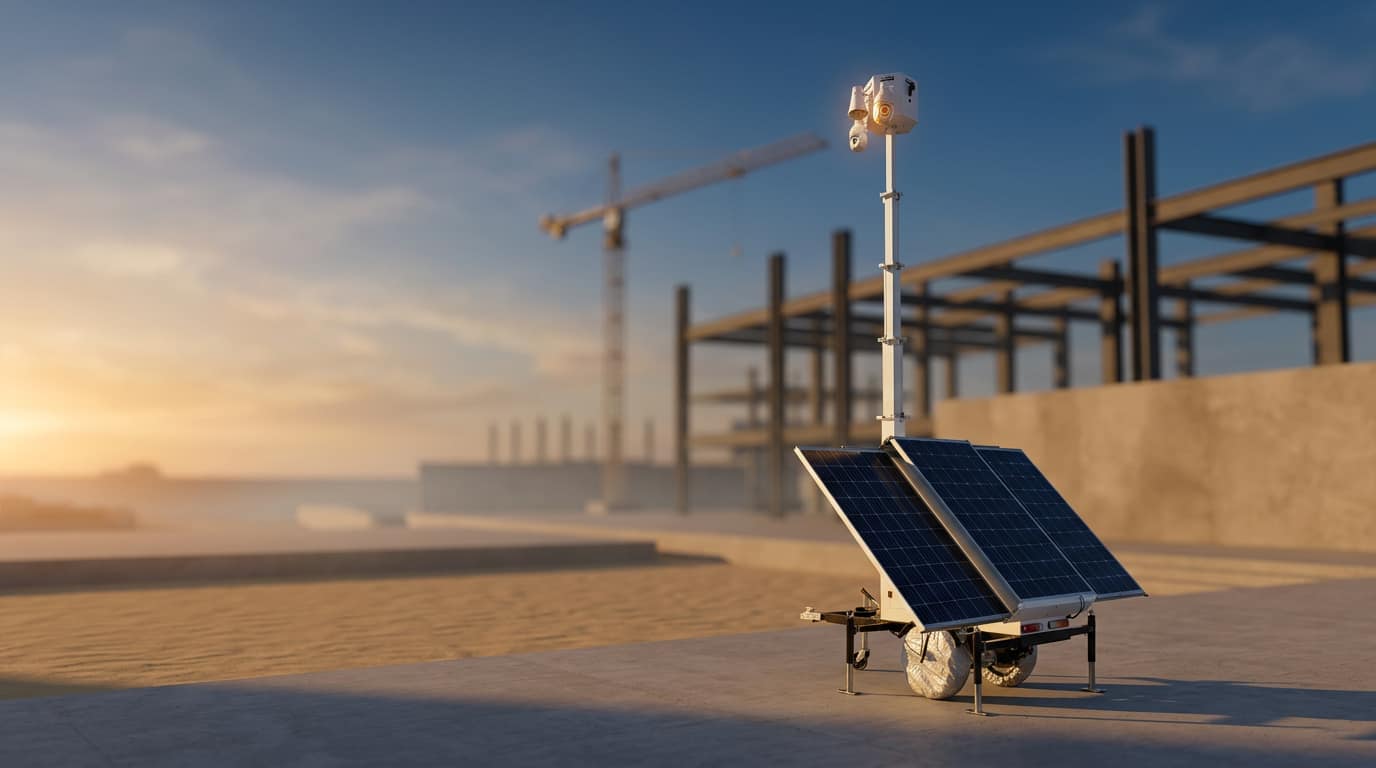
Crime Prevention Through Environmental Design (CPTED) applied to a Houston jobsite comes down to lighting, sightlines, defined boundaries, and maintenance. Sites that follow the checklist are meaningfully harder targets. The lighting layer is the highest-ROI investment. than un-CPTED sites in matched Guardtress deployment data. The lighting layer is the highest-ROI investment.
The four CPTED principles applied to a jobsite
Natural surveillance — sightlines from public streets into the site are unobstructed at critical corners. Solid privacy fencing is worse than chain-link on the theft-vulnerable perimeter.
Access control — a single primary ingress with defined pedestrian and vehicle paths. Multiple half-open ingress points are the pattern that thieves scout for.
Territorial reinforcement — signage, painted boundaries, and visible cameras communicate 'this site is claimed and watched.'
Maintenance — a well-maintained site signals presence; a debris-strewn site signals abandonment even during active work.
The lighting checklist
Minimum 5 foot-candles at all pedestrian ingress. Minimum 1 foot-candle across the working perimeter. Zero dark corners deeper than 15 feet from a lit area.
Warm-white (3000K–4000K) LED is easier on neighbor complaints than cool-white. Motion-triggered flood at the high-value asset apron is the highest-ROI single fixture.
- 5 fc at all pedestrian ingress
- 1 fc across working perimeter
- No dark corners >15ft from lit area
- Motion-triggered flood at high-value apron
- Warm-white LED (neighbor-friendly)
Sightlines and fencing
The instinct to solid-fence a jobsite for privacy backfires. It creates a visual barrier that means neighbors and passers-by can't see intrusion — and thieves inside the fence can't be seen either.
Chain-link with green privacy slats only at the office trailer window line gives you office privacy without killing the perimeter sightline. This is the configuration Guardtress recommends on most urban Houston sites.
Signage that actually works
Generic 'NO TRESPASSING' signs are wallpaper — thieves don't read them. Signs that reference specific active monitoring (Guardtress, 24/7 talkdown, LPR active, HPD dispatch) reduce approach frequency measurably.
Post at every ingress and at 150-ft intervals around the perimeter. Use both English and Spanish. Include the phone number of the monitoring center.
- Reference active monitoring by name
- Include monitoring center phone
- English + Spanish
- Every ingress + 150ft intervals
How fast can Guardtress deploy this in Houston?
Standard Guardtress deployments across the Houston metro land in 24–72 hours from signed quote to live monitoring. A single solar-powered mobile security trailer covers roughly 1.5–2 acres of open ground, carries 5–7 days of no-sun autonomy, and runs on bonded cellular so it needs no site power, no trenching, and no permanent mounting. Units relocate with a standard pintle hitch as the work front moves — a real advantage on phased Houston builds where the exposure point changes every few weeks.
Every unit ships with license plate recognition (LPR), analytic tripwires tuned to human and vehicle shapes, and two-way talkdown from a live U.S.-based monitoring center. Verified events escalate to the Houston Police Department or the Harris County Sheriff's Office as a confirmed crime in progress, which moves the call up the priority queue instead of into the false-alarm pile. Site plans, camera angles, and escalation contacts are set during a 30-minute assessment before the trailer leaves the yard.
- Assessment to live monitoring: 24–72 hours
- Coverage per unit: 1.5–2 acres, 360° with LPR at entry
- Power: solar with 5–7 days no-sun autonomy, no site power required
- Escalation: verified talkdown, then HPD / Harris County Sheriff dispatch
- Service area: Houston, Sugar Land, The Woodlands, Pasadena, Baytown, Conroe, Katy, Galveston, League City, Pearland
What does this cost compared with posting guards?
Houston contract guards run roughly $28–$42 per hour loaded, so a single unarmed guard on a 12-hour night shift costs about $10,000–$15,000 per month — for one set of eyes that can only be in one place, takes breaks, and turns over often. A monitored Guardtress trailer covers the same perimeter continuously at a fraction of that, and the spend moves from a headcount line to a predictable OPEX line you can hold to the schedule.
The math usually turns on two numbers: what a single loss event costs you in materials plus schedule slip, and whether your carrier offers any credit for a written 24/7 monitoring plan — a question worth asking your broker directly. Full site-by-site pricing is in our construction site security cost guide, and the head-to-head breakdown is at Guardtress vs. security guards.
- Houston guard rate: $28–$42/hour loaded
- One 12-hour guard shift: $10,000–$15,000/month
- Monitored trailer: fixed monthly OPEX, no overtime or turnover
- Builder's risk documentation: written monitoring plan formatted for broker review
Ready to lock in your perimeter?
30-minute remote or on-site assessment. Same-day quote. Deployment in 24–72 hours across the Houston metro.
Get a same-day quote