
License Plate Recognition Camera Specs — What Matters on a Jobsite LPR
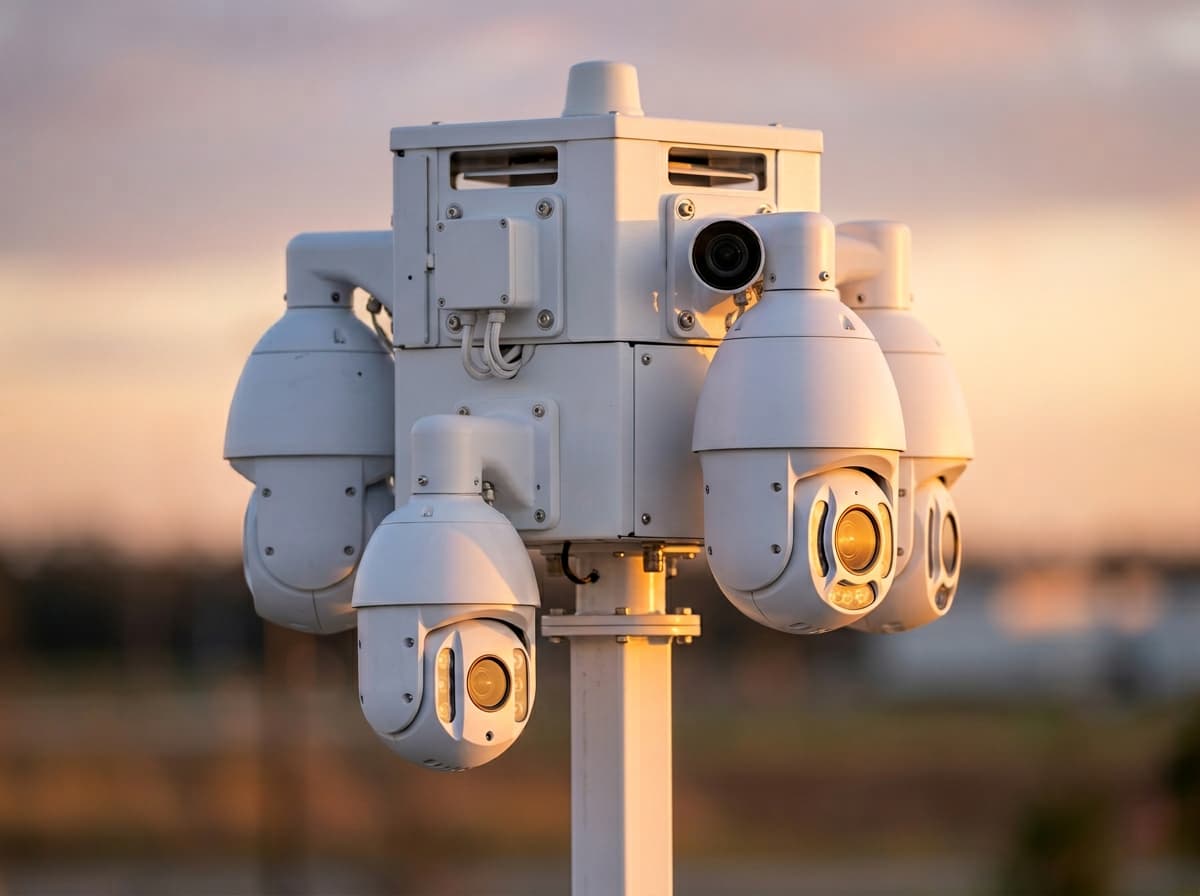
LPR camera performance on a jobsite ingress depends on lens focal length, IR illumination, shutter speed, and processor speed — not just megapixel count. Guardtress deploys purpose-built LPR cameras that read plates at 90–98% capture rate day or night, at vehicle speeds up to 40 mph, at distances up to 60 feet.
What actually matters in an LPR camera
Lens focal length: 5–50mm varifocal is standard for jobsite ingress at 20–60ft. Wrong focal length = plates too small or too warped.
Shutter speed: 1/1000 sec minimum to freeze a plate on a moving vehicle. Slower shutters blur.
IR illumination: 850nm IR at 100+ feet — LPR works in total darkness because it uses IR-reflective plate coating.
Processor: on-camera OCR is faster than cloud OCR by a factor of 3–5x.
- Lens: 5–50mm varifocal
- Shutter: 1/1000 sec minimum
- IR: 850nm at 100+ ft
- OCR: on-camera, not cloud
Capture rate benchmarks
90–98% capture on plates from vehicles within 60 feet of the camera at speeds up to 40 mph — day or night — is the modern benchmark. Older systems drop to 50–70% at night or above 20 mph.
Guardtress LPR is spec'd to the modern benchmark and independently validated on a monthly test protocol.
Common jobsite deployment mistakes
Wrong angle: LPR camera aimed too high or too shallow catches plates at an angle that OCR can't read. Optimal aim: 15–25 degrees off horizontal.
Wrong distance: cameras too far from the ingress lane can't resolve plate detail. Wrong height: too high and the plate is warped; too low and headlight glare washes it out.
Optimal mount: 12–16 feet high, 30–50 feet from ingress lane.
- Angle: 15–25° off horizontal
- Mount height: 12–16 ft
- Distance from ingress lane: 30–50 ft
- Aim: directly at plate line, not vehicle body
Storage and search
LPR reads are stored with timestamp, geo, and confidence score. Guardtress retains 90 days of reads per site by default; longer retention is available for enterprise deployments.
Client portal search allows plate lookup, wildcard match, and time-window filter. HPD coordination on active investigations uses the same search interface.
How fast can Guardtress deploy this in Houston?
Standard Guardtress deployments across the Houston metro land in 24–72 hours from signed quote to live monitoring. A single solar-powered mobile security trailer covers roughly 1.5–2 acres of open ground, carries 5–7 days of no-sun autonomy, and runs on bonded cellular so it needs no site power, no trenching, and no permanent mounting. Units relocate with a standard pintle hitch as the work front moves — a real advantage on phased Houston builds where the exposure point changes every few weeks.
Every unit ships with license plate recognition (LPR), analytic tripwires tuned to human and vehicle shapes, and two-way talkdown from a live U.S.-based monitoring center. Verified events escalate to the Houston Police Department or the Harris County Sheriff's Office as a confirmed crime in progress, which moves the call up the priority queue instead of into the false-alarm pile. Site plans, camera angles, and escalation contacts are set during a 30-minute assessment before the trailer leaves the yard.
- Assessment to live monitoring: 24–72 hours
- Coverage per unit: 1.5–2 acres, 360° with LPR at entry
- Power: solar with 5–7 days no-sun autonomy, no site power required
- Escalation: verified talkdown, then HPD / Harris County Sheriff dispatch
- Service area: Houston, Sugar Land, The Woodlands, Pasadena, Baytown, Conroe, Katy, Galveston, League City, Pearland
What does this cost compared with posting guards?
Houston contract guards run roughly $28–$42 per hour loaded, so a single unarmed guard on a 12-hour night shift costs about $10,000–$15,000 per month — for one set of eyes that can only be in one place, takes breaks, and turns over often. A monitored Guardtress trailer covers the same perimeter continuously at a fraction of that, and the spend moves from a headcount line to a predictable OPEX line you can hold to the schedule.
The math usually turns on two numbers: what a single loss event costs you in materials plus schedule slip, and whether your carrier offers any credit for a written 24/7 monitoring plan — a question worth asking your broker directly. Full site-by-site pricing is in our construction site security cost guide, and the head-to-head breakdown is at Guardtress vs. security guards.
- Houston guard rate: $28–$42/hour loaded
- One 12-hour guard shift: $10,000–$15,000/month
- Monitored trailer: fixed monthly OPEX, no overtime or turnover
- Builder's risk documentation: written monitoring plan formatted for broker review
Ready to lock in your perimeter?
30-minute remote or on-site assessment. Same-day quote. Deployment in 24–72 hours across the Houston metro.
Get a same-day quote