
Hurricane Season Jobsite Security in Houston
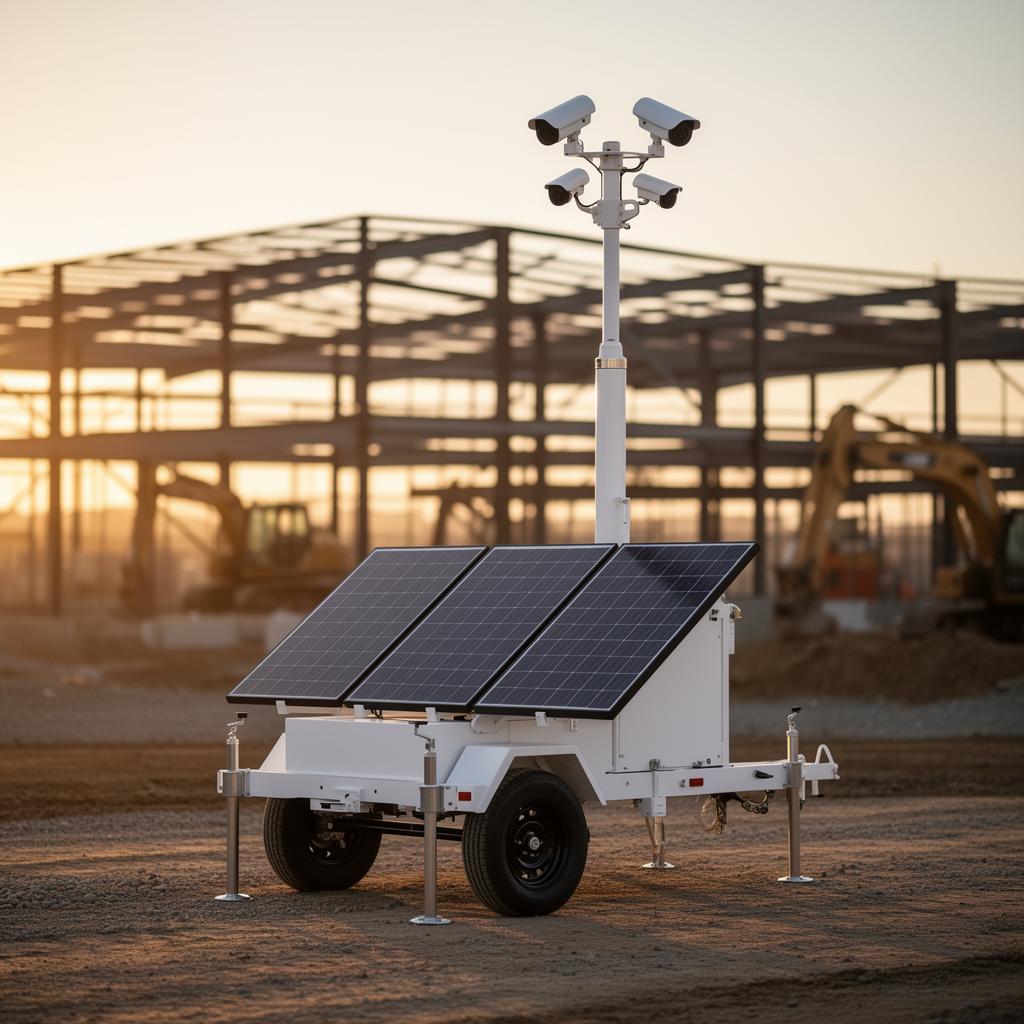
The 48 hours after a Gulf Coast tropical system is the highest-loss window in the Houston jobsite calendar — perimeter fencing is down, grid power is out, and HPD is prioritizing life-safety calls. A solar-powered mobile security trailer with 5–7 days of no-sun autonomy, bonded LTE across two carriers, and locally-based operators keeps the perimeter monitored when everything else fails.
Why is the post-storm window so dangerous?
Three things converge inside 48 hours of a Houston landfall: (1) perimeter fencing is blown down or leaned over across large sections of the site, (2) grid power is out for the neighborhood, disabling fixed CCTV that lacks battery backup, and (3) Houston Police Department is running life-safety triage, so property calls sit for hours.
After Hurricane Beryl (2024) and Tropical Storm Alberto (2024), post-storm intrusion pressure rose across the Houston metro — unmonitored sites were the most exposed.
What breaks on unprepared security setups
Fixed CCTV without battery backup goes dark inside 4 hours of grid loss. Single-carrier LTE modems lose uplink when Verizon or AT&T towers get congested. Guard companies pull staff for their own storm response and may not backfill for 24–72 hours. Recorded talkdown loops are ignored.
What a hurricane-hardened perimeter actually looks like
The Guardtress hurricane-season spec:
- Solar + 12 kWh LiFePO4 — 5–7 day no-sun autonomy, no grid dependency
- Bonded LTE across two carriers — auto-failover when one goes down
- 30+ day on-trailer video buffer — records even when uplink is lost
- Wind-rated deployment — trailer stows mast, hunkers on scissor jacks
- Local Houston operators — do not lose staffing when weather rolls in
- Pre-storm site walk — mast down, cameras stowed, spec confirmed
The 72-hour pre-storm playbook
When NHC issues a Houston-cone advisory 72 hours out, Guardtress runs the following on every deployed site:
- T-72h: site walk, mast stowed, cameras stowed, battery topped, telemetry verified
- T-48h: material staging locked (copper into conex), perimeter fence tie-down
- T-24h: shift to storm ops — reduced-power monitoring, on-trailer buffer confirmed
- Landfall: continuous telemetry; operators shift to hurricane mode
- T+24h: mast redeployed if wind sustained <30mph; monitoring resumes normal
- T+48h: perimeter fence audit, MEP material re-inventory, incident report filed
Insurance and documentation during named storms
Named-storm windows carry special claim scrutiny. Time-stamped video and monitoring logs are the difference between a paid claim and a denied one. Guardtress files a named-storm incident report with the GC and carrier within 72 hours of every landfall, even on zero-event sites — this becomes the paper trail if a later claim gets challenged.
How fast can Guardtress deploy this in Houston?
Standard Guardtress deployments across the Houston metro land in 24–72 hours from signed quote to live monitoring. A single solar-powered mobile security trailer covers roughly 1.5–2 acres of open ground, carries 5–7 days of no-sun autonomy, and runs on bonded cellular so it needs no site power, no trenching, and no permanent mounting. Units relocate with a standard pintle hitch as the work front moves — a real advantage on phased Houston builds where the exposure point changes every few weeks.
Every unit ships with license plate recognition (LPR), analytic tripwires tuned to human and vehicle shapes, and two-way talkdown from a live U.S.-based monitoring center. Verified events escalate to the Houston Police Department or the Harris County Sheriff's Office as a confirmed crime in progress, which moves the call up the priority queue instead of into the false-alarm pile. Site plans, camera angles, and escalation contacts are set during a 30-minute assessment before the trailer leaves the yard.
- Assessment to live monitoring: 24–72 hours
- Coverage per unit: 1.5–2 acres, 360° with LPR at entry
- Power: solar with 5–7 days no-sun autonomy, no site power required
- Escalation: verified talkdown, then HPD / Harris County Sheriff dispatch
- Service area: Houston, Sugar Land, The Woodlands, Pasadena, Baytown, Conroe, Katy, Galveston, League City, Pearland
What does this cost compared with posting guards?
Houston contract guards run roughly $28–$42 per hour loaded, so a single unarmed guard on a 12-hour night shift costs about $10,000–$15,000 per month — for one set of eyes that can only be in one place, takes breaks, and turns over often. A monitored Guardtress trailer covers the same perimeter continuously at a fraction of that, and the spend moves from a headcount line to a predictable OPEX line you can hold to the schedule.
The math usually turns on two numbers: what a single loss event costs you in materials plus schedule slip, and whether your carrier offers any credit for a written 24/7 monitoring plan — a question worth asking your broker directly. Full site-by-site pricing is in our construction site security cost guide, and the head-to-head breakdown is at Guardtress vs. security guards.
- Houston guard rate: $28–$42/hour loaded
- One 12-hour guard shift: $10,000–$15,000/month
- Monitored trailer: fixed monthly OPEX, no overtime or turnover
- Builder's risk documentation: written monitoring plan formatted for broker review
Ready to lock in your perimeter?
30-minute remote or on-site assessment. Same-day quote. Deployment in 24–72 hours across the Houston metro.
Get a same-day quote