
Edge AI Analytics on a Security Trailer — Cutting False Alarms
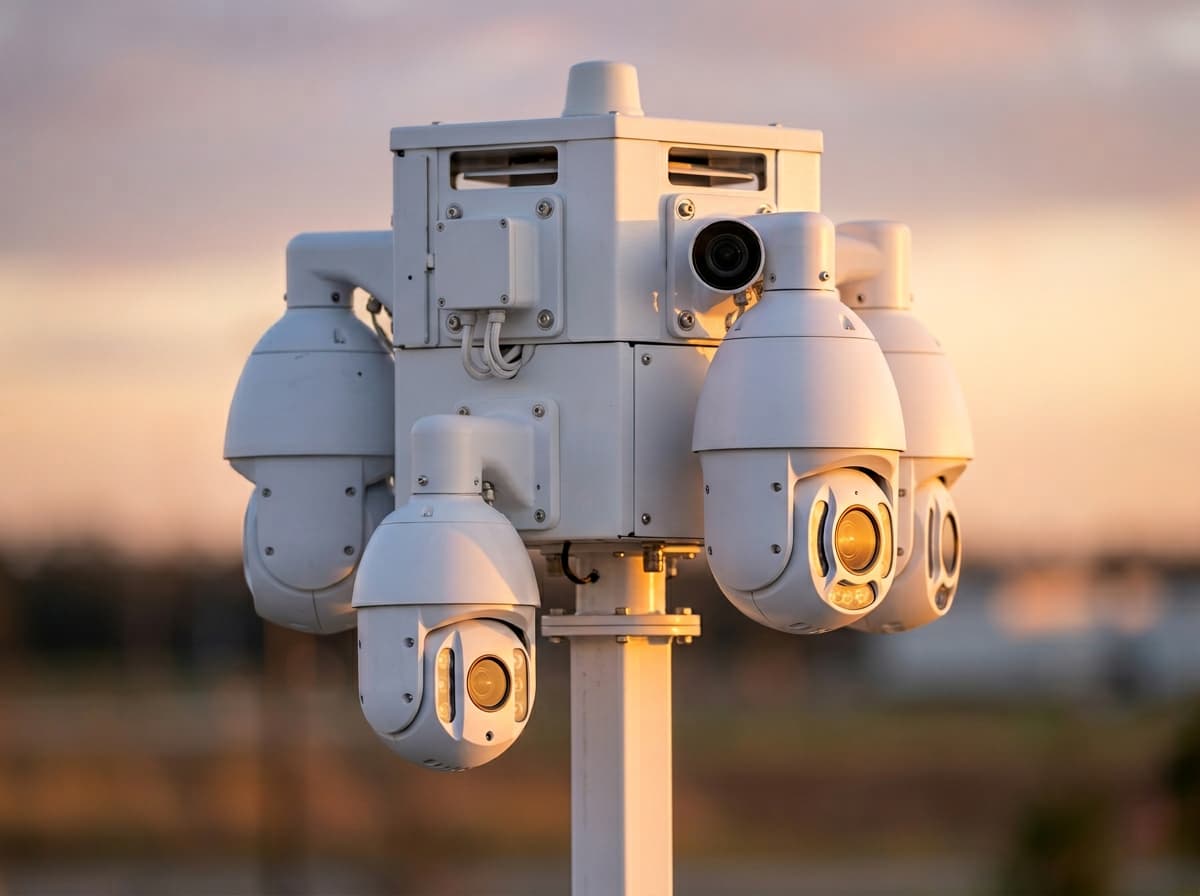
The single biggest gap between a modern monitored security trailer and a legacy one is edge AI analytics that classify events before an operator ever sees them. Guardtress trailers run on-device detection that filters out environmental false alarms — wildlife, waving flags, headlight sweep — so operators focus on real events.
The false alarm problem
Legacy motion-triggered cameras send every motion event to a monitoring center. Wind-blown flags, stray cats, adjacent-street headlights, and shadows generate hundreds of false alerts per site per night.
Operators triaging that flood miss real events. This is how systems fail even when the hardware is fine.
- Legacy motion alerts per site per night (unfiltered): 200–800
- Real intrusion events per site per night: 0–3
- Operator triage time per false alert: 10–30 sec
- Missed real events at high false-alarm sites: material
What edge AI actually does
Modern trailers run on-device neural nets that classify every motion event as person / vehicle / animal / environment before it ever leaves the trailer.
The monitoring center receives only person and vehicle events. Animals and environmental noise are filtered out entirely.
The measured reduction
Edge classification removes the large majority of environmental noise before an operator ever sees it, while detection thresholds are tuned to prioritize real person and vehicle events.
That is a dramatic reduction in noise, with detection tuned to prioritize real events. Operators can respond quickly because they are looking at a short list of real events per shift instead of hundreds of unfiltered motion alerts.
- False alarm filtering: environmental noise removed on-device
- Real-event detection: prioritized in threshold tuning
- Operator throughput: focused on real events
- Response achievability: transformed
What else edge AI enables
Loitering detection: person stationary in a zone for >N seconds. Perimeter crossing detection: person or vehicle crosses a defined line. PPE detection: worker on-site without hardhat during working hours (safety layer, not security).
Vehicle classification: distinguishing a legitimate delivery truck from a passenger vehicle at 3am. All of this happens on-device without cloud latency.
How fast can Guardtress deploy this in Houston?
Standard Guardtress deployments across the Houston metro land in 24–72 hours from signed quote to live monitoring. A single solar-powered mobile security trailer covers roughly 1.5–2 acres of open ground, carries 5–7 days of no-sun autonomy, and runs on bonded cellular so it needs no site power, no trenching, and no permanent mounting. Units relocate with a standard pintle hitch as the work front moves — a real advantage on phased Houston builds where the exposure point changes every few weeks.
Every unit ships with license plate recognition (LPR), analytic tripwires tuned to human and vehicle shapes, and two-way talkdown from a live U.S.-based monitoring center. Verified events escalate to the Houston Police Department or the Harris County Sheriff's Office as a confirmed crime in progress, which moves the call up the priority queue instead of into the false-alarm pile. Site plans, camera angles, and escalation contacts are set during a 30-minute assessment before the trailer leaves the yard.
- Assessment to live monitoring: 24–72 hours
- Coverage per unit: 1.5–2 acres, 360° with LPR at entry
- Power: solar with 5–7 days no-sun autonomy, no site power required
- Escalation: verified talkdown, then HPD / Harris County Sheriff dispatch
- Service area: Houston, Sugar Land, The Woodlands, Pasadena, Baytown, Conroe, Katy, Galveston, League City, Pearland
What does this cost compared with posting guards?
Houston contract guards run roughly $28–$42 per hour loaded, so a single unarmed guard on a 12-hour night shift costs about $10,000–$15,000 per month — for one set of eyes that can only be in one place, takes breaks, and turns over often. A monitored Guardtress trailer covers the same perimeter continuously at a fraction of that, and the spend moves from a headcount line to a predictable OPEX line you can hold to the schedule.
The math usually turns on two numbers: what a single loss event costs you in materials plus schedule slip, and whether your carrier offers any credit for a written 24/7 monitoring plan — a question worth asking your broker directly. Full site-by-site pricing is in our construction site security cost guide, and the head-to-head breakdown is at Guardtress vs. security guards.
- Houston guard rate: $28–$42/hour loaded
- One 12-hour guard shift: $10,000–$15,000/month
- Monitored trailer: fixed monthly OPEX, no overtime or turnover
- Builder's risk documentation: written monitoring plan formatted for broker review
Ready to lock in your perimeter?
30-minute remote or on-site assessment. Same-day quote. Deployment in 24–72 hours across the Houston metro.
Get a same-day quote