
Cellular Failover on a Mobile Security Trailer — The Connectivity Stack
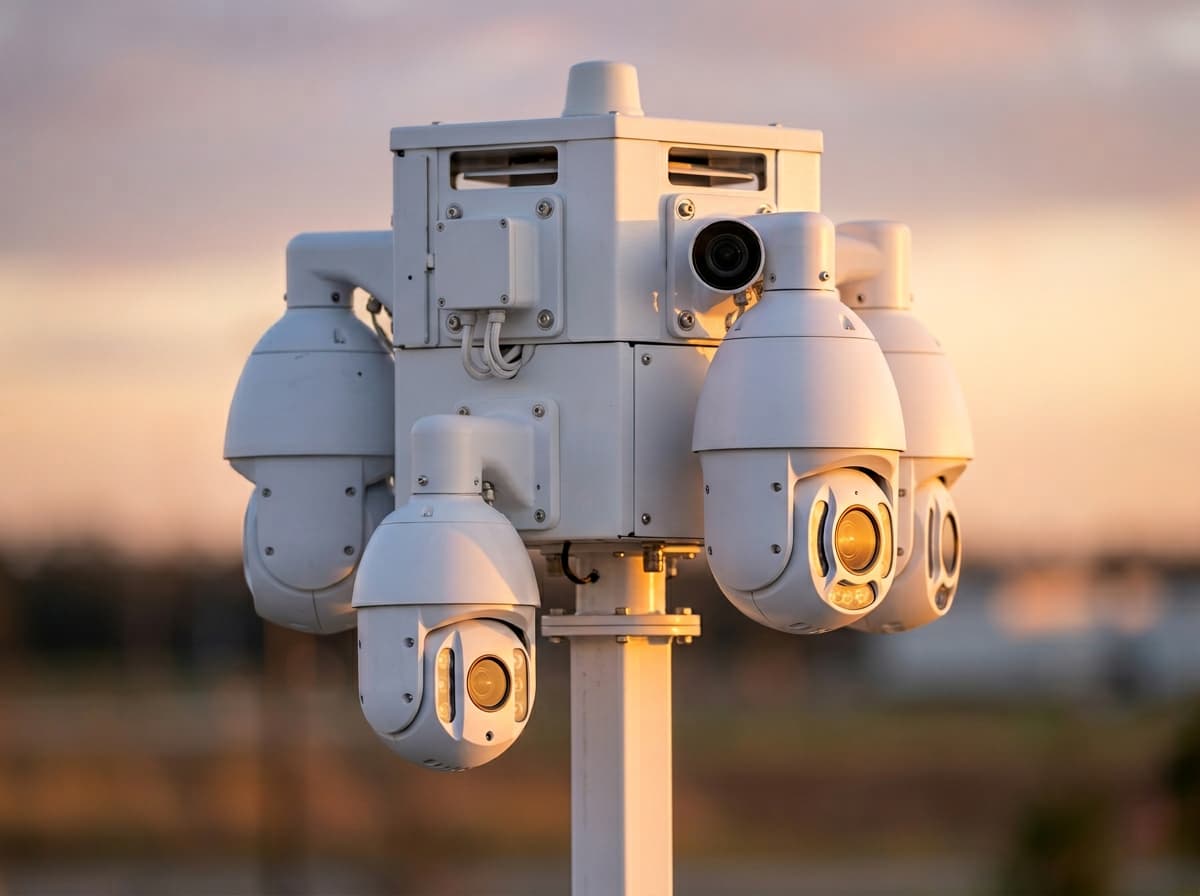
A monitored security trailer is only as good as its connectivity. Guardtress trailers ship with multi-carrier cellular (Verizon + AT&T + T-Mobile) and satellite failover, designed to keep the perimeter connected through single-carrier outages and storm events. The stack — SIM management, failover logic, satellite fallback — is what turns 'usually connected' into 'always connected.'
The three connectivity failure modes
Single-carrier outage: one carrier has a tower issue in your zip code. Common — happens 4–8 times per year per carrier per Houston zip.
Storm-driven multi-carrier outage: extreme weather damages towers or floods equipment. 2–5 times per year in the Houston metro at meaningful scale.
Site-specific dead zone: your specific ingress corner has weak signal on one carrier even when the metro is fine.
The Guardtress connectivity stack
Primary: bonded Verizon 5G modem with external antenna.
Secondary: AT&T 5G modem with independent antenna, hot-standby.
Tertiary: T-Mobile 5G modem for edge zones where AT&T is weak.
Quaternary: Starlink or Iridium satellite failover for total cellular outage.
Failover logic: sub-3-second automatic handoff, tested weekly.
- Primary: Verizon 5G
- Secondary: AT&T 5G
- Tertiary: T-Mobile 5G
- Quaternary: Starlink satellite
- Handoff latency: <3 sec
- Design target: always connected
Why single-carrier trailers fail
A trailer with only one cellular modem is a trailer that drops offline during any single-carrier event. Some competitor units ship this way and it is invisible until an event.
Ask any prospective vendor to show 30 days of their uptime log. If they can't, that is your answer.
On-board local recording during outage
If all cellular and satellite drop simultaneously, the on-board NVR continues recording locally with 30 days of storage. When connectivity returns, footage syncs to cloud in the background.
You lose real-time monitoring during the outage window, but you do not lose the footage. And multi-carrier + satellite makes that window vanishingly rare.
How fast can Guardtress deploy this in Houston?
Standard Guardtress deployments across the Houston metro land in 24–72 hours from signed quote to live monitoring. A single solar-powered mobile security trailer covers roughly 1.5–2 acres of open ground, carries 5–7 days of no-sun autonomy, and runs on bonded cellular so it needs no site power, no trenching, and no permanent mounting. Units relocate with a standard pintle hitch as the work front moves — a real advantage on phased Houston builds where the exposure point changes every few weeks.
Every unit ships with license plate recognition (LPR), analytic tripwires tuned to human and vehicle shapes, and two-way talkdown from a live U.S.-based monitoring center. Verified events escalate to the Houston Police Department or the Harris County Sheriff's Office as a confirmed crime in progress, which moves the call up the priority queue instead of into the false-alarm pile. Site plans, camera angles, and escalation contacts are set during a 30-minute assessment before the trailer leaves the yard.
- Assessment to live monitoring: 24–72 hours
- Coverage per unit: 1.5–2 acres, 360° with LPR at entry
- Power: solar with 5–7 days no-sun autonomy, no site power required
- Escalation: verified talkdown, then HPD / Harris County Sheriff dispatch
- Service area: Houston, Sugar Land, The Woodlands, Pasadena, Baytown, Conroe, Katy, Galveston, League City, Pearland
What does this cost compared with posting guards?
Houston contract guards run roughly $28–$42 per hour loaded, so a single unarmed guard on a 12-hour night shift costs about $10,000–$15,000 per month — for one set of eyes that can only be in one place, takes breaks, and turns over often. A monitored Guardtress trailer covers the same perimeter continuously at a fraction of that, and the spend moves from a headcount line to a predictable OPEX line you can hold to the schedule.
The math usually turns on two numbers: what a single loss event costs you in materials plus schedule slip, and whether your carrier offers any credit for a written 24/7 monitoring plan — a question worth asking your broker directly. Full site-by-site pricing is in our construction site security cost guide, and the head-to-head breakdown is at Guardtress vs. security guards.
- Houston guard rate: $28–$42/hour loaded
- One 12-hour guard shift: $10,000–$15,000/month
- Monitored trailer: fixed monthly OPEX, no overtime or turnover
- Builder's risk documentation: written monitoring plan formatted for broker review
Ready to lock in your perimeter?
30-minute remote or on-site assessment. Same-day quote. Deployment in 24–72 hours across the Houston metro.
Get a same-day quote